March 30, 2026
This policy brief examines why the US-Israeli war on Iran, now in its fifth week, has failed to produce the regime collapse many Western policymakers anticipated. Despite significant elite losses and sustained military and economic pressure, mass uprisings have not materialized, and the regime has at times appeared to gain the upper hand internationally.
This brief identifies five persistent myths in Western policy thinking. First, the assumption that killing leaders will cause systemic collapse ignores Iran's deliberately layered institutional architecture. Second, the expectation of a unified opposition overlooks deep fragmentation among reformist, monarchist, secular, and diaspora factions. Third, the belief that external pressure empowers domestic reformers disregards how foreign intervention triggers nationalist backlash and enables the regime to frame dissent as foreign-backed. Fourth, reducing the regime's legitimacy to coercion alone misses its roots in revolutionary history, Shi'a identity, and narratives of resistance. Fifth, the expectation that war-induced suffering will turn citizens against the state underestimates how civilian casualties, such as the Minab school strike, redirect anger toward foreign attackers.
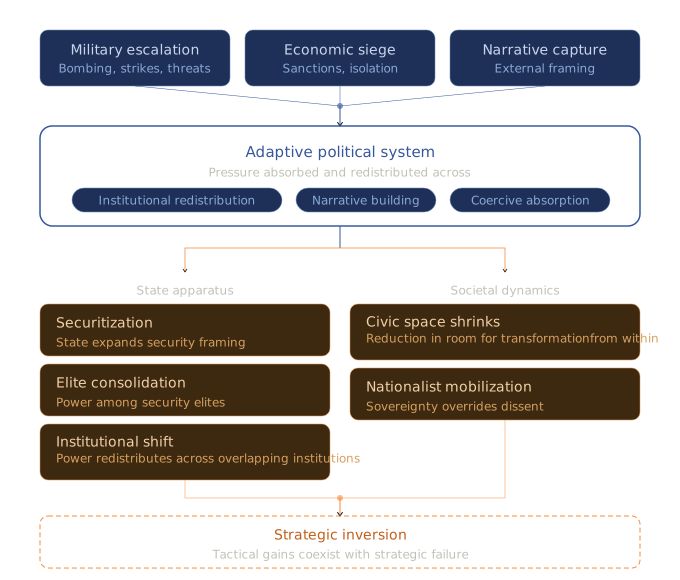
We conclude that Iran functions as an adaptive political system, not a brittle state awaiting collapse. Pressure is absorbed and redistributed across institutions and narratives. The policy recommendations call for a shift from maximalist coercion to calibrated de-escalation, expansion of civic space, protection of humanitarian channels, and a recentering of Iranian agency over diaspora representation. The guiding principle: effective policy expands the space for internally driven change rather than attempting to engineer outcomes from abroad.